






Aimed at preventing radicalism Exchange of experience between Kazakhstan and Turkey
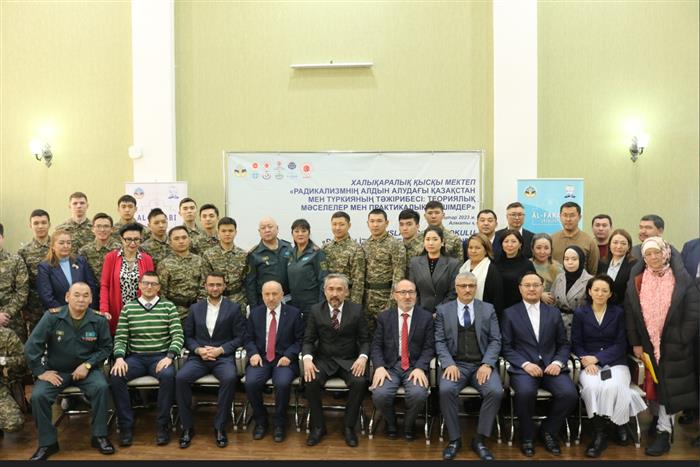
From January 23 to January 25, 2023, the Department of Religious Studies and Cultural Studies of the Faculty of Philosophy and Political Science of the Al-Farabi Kazakh National University, the Department of Philosophy, the Center for Religious Studies and Expertise, the Al-Farabi Center and the Consulate General of the Republic of Turkey in Almaty, the Attache for Religious Affairs of Turkey (Diyanet), the Turkiye Diyanet Vakfı Foundation (TDV-In the conference hall of the library of KazNU named after Farabi "the experience of Kazakhstan and Turkey in the prevention of radicalism: theoretical problems and practical solutions".
The meeting was moderated by the Dean of the Faculty of Philosophy and Political Science of Al-Farabi Kazakh National University Bekzhan Meyrbayev, Head of the Department of Religious Studies and Cultural Studies of Al-Farabi Kazakh National University Ainur Kurmanalieva, Adviser on Religious Affairs of the Embassy of the Republic of Turkey in Astana Neshet Bodur, Head of the Center for the Study of Terrorism and Extremism in Kazakhstan Bishmanov Kakimzhan, Head of the Consulate General of the Republic of Turkey Attache for Emrulla Uzum Affairs, H. A. Professor of the International Kazakh-Turkish University named after the President of the Republic of Kazakhstan in Almaty.Yasavi became Matin Yilmaz.
Dean of the Faculty of Philosophy and Political Science of Al-Farabi Kazakh National University Bekzhan Meirbayev, Attache for Religious Affairs of the Consulate General of the Republic of Turkey in Almaty Emrulla Uzum, Adviser for Religious Affairs of the Embassy of the Republic of Turkey in Astana Neshet Bodur and Head of the Department for Religious Affairs of Almaty Nurlan Kikimov made welcoming speeches.
During the Winter School, coordinator of the Turkey Diyanet Wakf Foundation, PhD Osman Turk, Vice-Rector of the Egyptian University of Islamic Culture Nur-Mubarak, PhD Kairat Kurmanbayev, specialist of the center "Counseling and Rehabilitation" at the Department of Religious Affairs of Almaty Nazerke Zhetpisbay, researcher at the Institute of Security Sciences of the Academy of Police, PhD (Turkey) Hakan Kiizhi, Director of the Security Research Department of the Center for Middle East Studies (ORSAM), PhD, Associate Professor Goktugug, Associate Professor of the Department of International Relations and World Economy of the Kazakh National University. Al-Farabi, PhD Leyla Delovarova, H. A. Professor of the International Kazakh-Turkish University. Yasavi, PhD Matin Yilmaz, expert of the information and explanatory group on the prevention of religious extremism and terrorism, Senior Lecturer of the Department of Religious Studies and Cultural Studies Elnar Berikbayev, Head of the Department of Religious Studies and Cultural Studies of Al-Farabi Kazakh National University Ainur Kurmanalieva, Head of the Center for the Study of Religious Problems of the Department of Religious Affairs of Almaty Dulat Ibrahimov, Head of the Department of Sociology and Social works of KazNU named after. Al-Farabi, Doctor of Sociology, Professor Gulmira Abdraimova, Al-Farabi Kazakh National University, Head of the Department of Pedagogy and Management of Education, Candidate of Pedagogical Sciences, Professor Nursultan Algozhayeva, Al-Farabi Kazakh National University, Head of the Department of General and Applied Psychology, Doctor of Pedagogical Sciences, Professor Aigerim Mynbayeva, Professor Aimagambetova O. H., Al-Farabi Kazakh National University, Head of the Department of Philosophy, Candidate of Philosophical Sciences Asset Kuranbek made reports.
The meeting was held in a discus format, debates and new ideas were discussed under the supervision of moderators.
Today it is no secret that religious radicalism has become a global problem that requires an urgent, speedy solution for Kazakhstan and Turkey and even the whole world. This issue affects state security, the main pillars of statehood, including democracy, that is, the personal rights and obligations of each person. While previously these situations were considered as a specific issue, solved only by the intervention of the state, located far from the population, under the supervision of state security agencies, today it is no secret that this problem is the tragedy of every family, including our distant and close relatives.
At the Winter School, the history of the origin of religious radicalism, the causes of its occurrence and ways to combat radicalism were discussed, many practical recommendations were put forward. The organization of these anti-epidemic measures in two countries was also considered, the results of their implementation were shared, the results of each country were shared. The speakers at the meeting said that religious radicalism is not an independent problem of one state, that individual countries cannot overcome it, but only jointly overcome this problem.
During the meeting, a direct link between religious extremism and the general literacy of the population, including religious literacy, was revealed. That is, many problems arise due to the superficiality of citizens' education, including religious education. As a result, without properly forming your thoughts and opinions, you can meet a lot of negative opinions and false statements. It does not just lead to a delusion of personality, a lost personality attracts family, relatives, colleagues and acquaintances. This undermines the peace and integrity of our state, as radical currents are practically opposed to state policy, customs and traditions of our people, the principles of the clergy.
It is obvious that our sovereignty is in very great danger if we fail to resolve the issues under consideration in time. This applies not only to Islamic fundamentalism, including the Salafist movement. For example, the burning of the book of the Koran in the Swedish country, which happened only yesterday, also caused international tension.
We are confident that the issues discussed at the Winter School will provide more information not only to professional theologians and philosophers, but also to the general population as a whole, and will also provide more information to state competent authorities to cope with these problems.
Arailym Shanbayeva
1st year doctoral student of the specialty "6D021500-Islamic Studies"
Zhanna Kantarbayeva
Senior Lecturer of the Department of Religious Studies and Cultural Studies,
Candidate of Philosophical Sciences