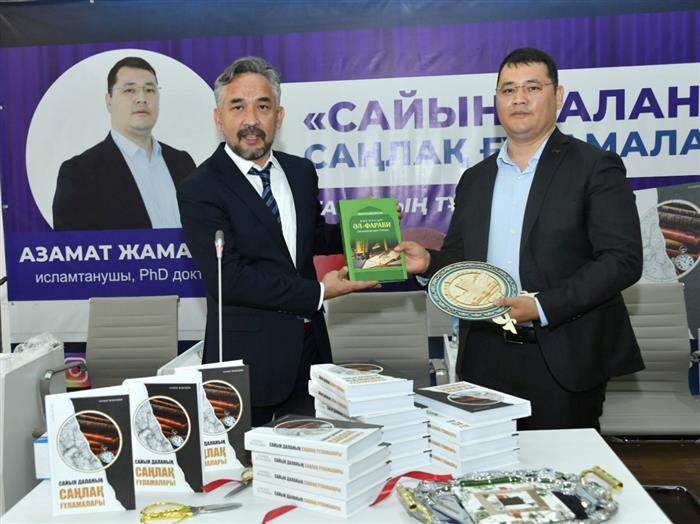







The presentation of the book about the sages took place
The presentation of the book of Hadith scholar, PhD, senior lecturer Azamat Zhamashev "Sayyn dalanyn sanlak gulamalary" was held at the Al-Farabi Kazakh National University. The event was attended by representatives of "Gylym Ordasy", researchers of the regional university, faculty and young applicants.
The work describes in detail the state of medieval cities of the Kazakh steppe, everyday life, religious situation and personality of the inhabitants of the city.
Opening the ceremony, the dean of the Faculty of Philosophy and Political Science Bekzhan Meirbayev focused on the originality and novelty of the book.
"The study examined sources that are absent in modern religious circulation, written in Kazakh, Russian, Arabic, Turkish, and English, and described the life history of 437 sages who lived to the XX century. We believe that this is a significant contribution to Kazakh science," the dean of the faculty said.
The general structure of the book includes 14 regions grouped into five economic districts. First, a brief description of the area is given, including information about medieval cities. This brief information is followed by information about the religious situation in the region before the beginning of the XX century, mosques, madrasas and personalities. At the end there is a map with a description of the localities where people lived and a list of their chronology. The study included more than 400 sources in Kazakh, Russian, Arabic, Turkish and English.
Speaking at the meeting, colleagues of the scientist noted that the author effectively used the foreign experience of scientific research. According to them, the publication is the result of many years of research.
Azamat Zhamashev is the author of the books "Hadiths – the source of science", "Hadistan ilimi" and many other publications. Today he teaches at the Department of Religious Studies and Cultural Studies of the Faculty of Philosophy and Political Science.
The event was organized by the Department of Religious Studies and Cultural Studies of the Faculty of Philosophy and Political Science of Al-Farabi Kazakh National University, the Center for Religious Studies and Expertise and the Al-Farabi Center.